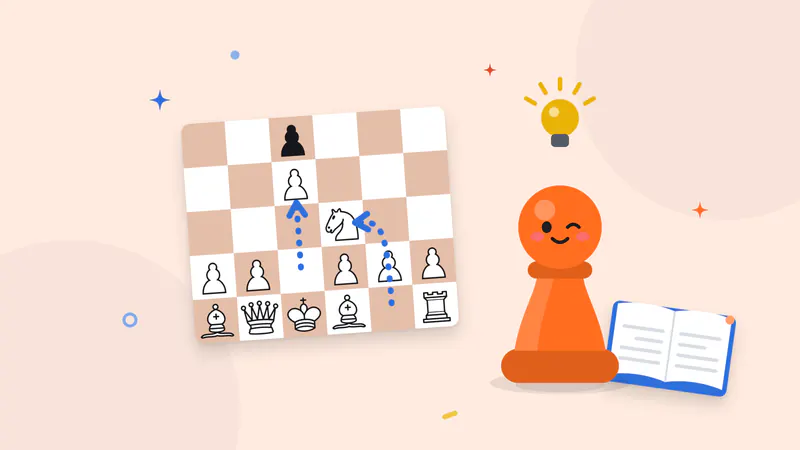
Chess is a strategy game for two players on a board of 64 squares. Each player starts with 16 pieces, and the aim is to checkmate the opposing king: attack it so that it cannot escape. There is no luck involved and no hidden information; everything depends on the moves you choose. This guide covers the complete standard rules, including the special moves that confuse new players, and states exactly how the chess game on this site applies them.
Overview
- Players: 2 (White and Black).
- Ages: usually taught from about 6 years old; there is no upper limit.
- Time: a casual game takes 10 to 60 minutes; with a clock it is as long as the time control allows.
- Equipment: an 8×8 board of alternating light and dark squares, and for each side one king, one queen, two rooks, two bishops, two knights and eight pawns.
The rules here follow the FIDE Laws of Chess, published by FIDE, the international chess federation. Official tournaments, clubs and chess sites around the world play by them.
Setup
Place the board so that each player has a light square in the right-hand corner (“light on the right”). The files (columns) are labeled a to h from White’s left to right, and the ranks (rows) 1 to 8 from White’s side. White’s pieces go on ranks 1 and 2, Black’s on ranks 8 and 7.
| Square | a | b | c | d | e | f | g | h |
|---|---|---|---|---|---|---|---|---|
| Rank 1 and 8 | Rook | Knight | Bishop | Queen | King | Bishop | Knight | Rook |
| Rank 2 and 7 | Pawn | Pawn | Pawn | Pawn | Pawn | Pawn | Pawn | Pawn |
The queens start on their own color: the white queen on d1 (a light square), the black queen on d8 (a dark square). The kings face each other on the e-file.
Objective
You win by checkmate: the enemy king is attacked (in check), and no legal move gets it out of check. The king is never actually captured; the game ends at checkmate. You also win if your opponent resigns, or if their clock runs out while you still have enough material to checkmate.
Turns
White moves first. Players then alternate, one move per turn. A move is either moving one piece to an empty square or capturing an enemy piece by moving onto its square and removing it from the board. You cannot pass, and you must move if you have a legal move, even if every move hurts your position. Castling is the only move in which two of your pieces move at once.
How the pieces move
King
One square in any direction. The king may never move onto a square attacked by an enemy piece, and the two kings can never stand next to each other.
Queen
Any number of squares in a straight line: along a rank, a file or a diagonal. It cannot jump over pieces. The queen is the strongest piece.
Rook
Any number of squares along a rank or a file, without jumping.
Bishop
Any number of squares diagonally, without jumping. A bishop stays on the color it started on for the whole game, which is why each side has one light-squared and one dark-squared bishop.
Knight
In an L-shape: two squares in one straight direction, then one square to the side. The knight is the only piece that jumps over other pieces, and it always lands on a square of the other color.
Pawn
Straight forward one square to an empty square. On its very first move a pawn may go two squares forward instead, if both squares are empty. Pawns capture differently from how they move: one square diagonally forward. Pawns never move backward or sideways.
Special rules
Check
A king attacked by an enemy piece is in check. The player in check must get out of it on that move, in one of three ways: move the king to a safe square, block the attack by putting a piece in between (impossible against a knight or an adjacent piece), or capture the attacking piece. You may never make a move that puts or leaves your own king in check; such a move is illegal. On this site illegal moves simply aren’t offered, and the king in check is highlighted.
Castling
Once per game each player may castle: the king moves two squares toward a rook, and that rook jumps to the square the king crossed. Kingside castling puts the white king on g1 and the rook on f1 (Black: g8 and f8); queenside castling puts the king on c1 and the rook on d1 (Black: c8 and d8). Castling is allowed only if:
- neither the king nor that rook has moved yet in the game (a piece that moved away and came back still counts as moved);
- all squares between the king and the rook are empty;
- the king is not in check;
- the king does not pass through or land on a square attacked by the opponent.
The rook may be attacked, and on the queenside it may cross an attacked square (b1 or b8); only the king’s path matters. To castle here, move the king two squares and the rook follows.
En passant
When a pawn moves two squares from its starting position and lands right beside an enemy pawn, that enemy pawn may capture it as if it had moved only one square. The capturing pawn moves diagonally to the square the other pawn skipped, and the pawn that moved two squares is removed. Example: a white pawn on e5, Black plays d7–d5; White may answer exd6, removing the pawn on d5. The capture must be made immediately, on the very next move, or the chance is gone. Like any move, it is illegal if it would leave your king in check.
Promotion
A pawn that reaches the far rank (rank 8 for White, rank 1 for Black) is promoted: it is replaced by a queen, rook, bishop or knight of the same color, as the player chooses. It cannot stay a pawn or become a king. The choice does not depend on captured pieces, so a player can have several queens. On this site a picker with the four choices appears; cancel it and the pawn returns to its square.
Winning, drawing and ending the game
Ways to win
- Checkmate.
- Resignation: a player may give up at any time. On this site, Resign gives up for the player whose turn it is (against the computer, for you).
- Time: with a clock, a player whose time runs out loses, unless the opponent could not checkmate by any series of legal moves. Then the game is a draw (see below).
Ways to draw
- Stalemate: the player to move has no legal move and is not in check.
- Agreement: one player offers a draw and the other accepts. Here, Offer a draw in the More menu asks the opponent to accept or decline on the same screen. The computer accepts when it is behind on material, or when the material is level later in the game.
- Threefold repetition: the same position occurs three times with the same player to move and the same castling and en passant rights.
- 50-move rule: 50 moves by each player (100 moves in total) with no capture and no pawn move.
- Insufficient material: so little material is left that neither side can checkmate: king against king, king and bishop against king, king and knight against king, or kings with bishops that all stand on squares of one color. The game ends automatically in exactly these cases. Other dead positions, such as pawn chains locked so that no piece can ever get through, are rare; here they play on until the 50-move rule, a repetition or an agreed draw ends them.
- Time out against insufficient material: your time runs out, but your opponent could never checkmate with what they have left: a lone king; a king and one knight while you have nothing but your king and any queens; or a king and bishops all on one color while you have no pawns, no knights and no bishop on the other color. The game is then a draw.
Timing
Casual games are often played without a clock. With a chess clock each player has a time budget for the whole game, and only the clock of the player to move runs. An increment adds a few seconds after each of your moves: “3+2” means 3 minutes each plus 2 seconds per move. This site offers None, 3+2, 5+0, 10+0 and 15+10 (minutes each, plus seconds added per move). The clock pauses while the pass screen or a dialog is showing and while the page is in the background. Undo puts both clocks back to the times they showed when that position was first on the board, so a taken-back move never earns an increment; the time spent thinking about the move you took back is returned too, which is why players who want strict timing agree not to use Undo in clocked games.
Notation basics
Games are written down in algebraic notation, which the move list here uses. Every square has a name: its file letter and rank number, such as e4. Pieces are written with capital letters, K king, Q queen, R rook, B bishop, N knight, and pawns with no letter. So:
- e4 – a pawn moves to e4; Nf3 – a knight moves to f3.
- x marks a capture: Bxf7, or for a pawn its file: exd5.
- + check, # checkmate.
- O-O kingside castling, O-O-O queenside castling.
- e8=Q promotion to a queen.
- If two identical pieces could reach the same square, the starting file or rank is added: Nbd2, R1e2.
A move number counts a White move and the Black reply together: “1. e4 e5 2. Nf3 Nc6”.
Variants and the rules this site uses
The site plays standard chess with the full FIDE movement rules. A few points are adapted for casual play on one device, and they are the same in every game:
- Automatic draws. Threefold repetition and the 50-move rule end the game immediately. Under FIDE rules a player must claim these draws (and only five repetitions or 75 moves end the game by themselves); many casual and online games end them automatically, as here.
- Touch-move is not enforced. Tapping a piece selects it; tapping it again deselects it.
- Undo is available for friendly games. Against the computer it returns to your previous move.
- Timeout vs insufficient material is a draw, following FIDE Article 6.9.
Popular variants such as Chess960 (shuffled back ranks), three-check and crazyhouse aren’t offered, so you can rely on the standard starting position. Some families allow house rules like “no stalemate”, but here stalemate is always a draw.
Common mistakes and rule disputes
- “Stalemate means I win.” It doesn’t: a player with only a king who has no legal move draws.
- Castling after the king moved. Moving the king once, even back to e1, removes both castling rights for the rest of the game.
- Castling with a moved rook. The other rook may still castle if it hasn’t moved.
- Forgetting en passant. It is only possible right after the two-square pawn move, never later.
- Promoting only to a captured piece. You may always choose a queen, even if you still have one.
- Moving into check by accident. Illegal; on this board such moves simply aren’t available.
- Thinking the king can be captured. The game ends at checkmate; a king is never taken.
Glossary
- Check / checkmate: the king is attacked / attacked with no escape.
- Stalemate: no legal move while not in check; a draw.
- Castling: the king and rook move together once per game.
- En passant: “in passing”; capturing a pawn that has just moved two squares.
- Promotion: a pawn on the last rank becomes another piece.
- Rank / file / diagonal: a row / a column / a slanted line of squares.
- Material: the pieces a player has; common values are pawn 1, knight 3, bishop 3, rook 5, queen 9.
- Fork: one piece attacking two enemy pieces at once.
- Pin: a piece that can’t move without exposing a more valuable piece behind it.
- Increment: time added to a player’s clock after each of their moves.
- Resign: give up the game.
To put the rules into practice, start with the beginner chess tutorial, then play chess on one device or against the computer.